
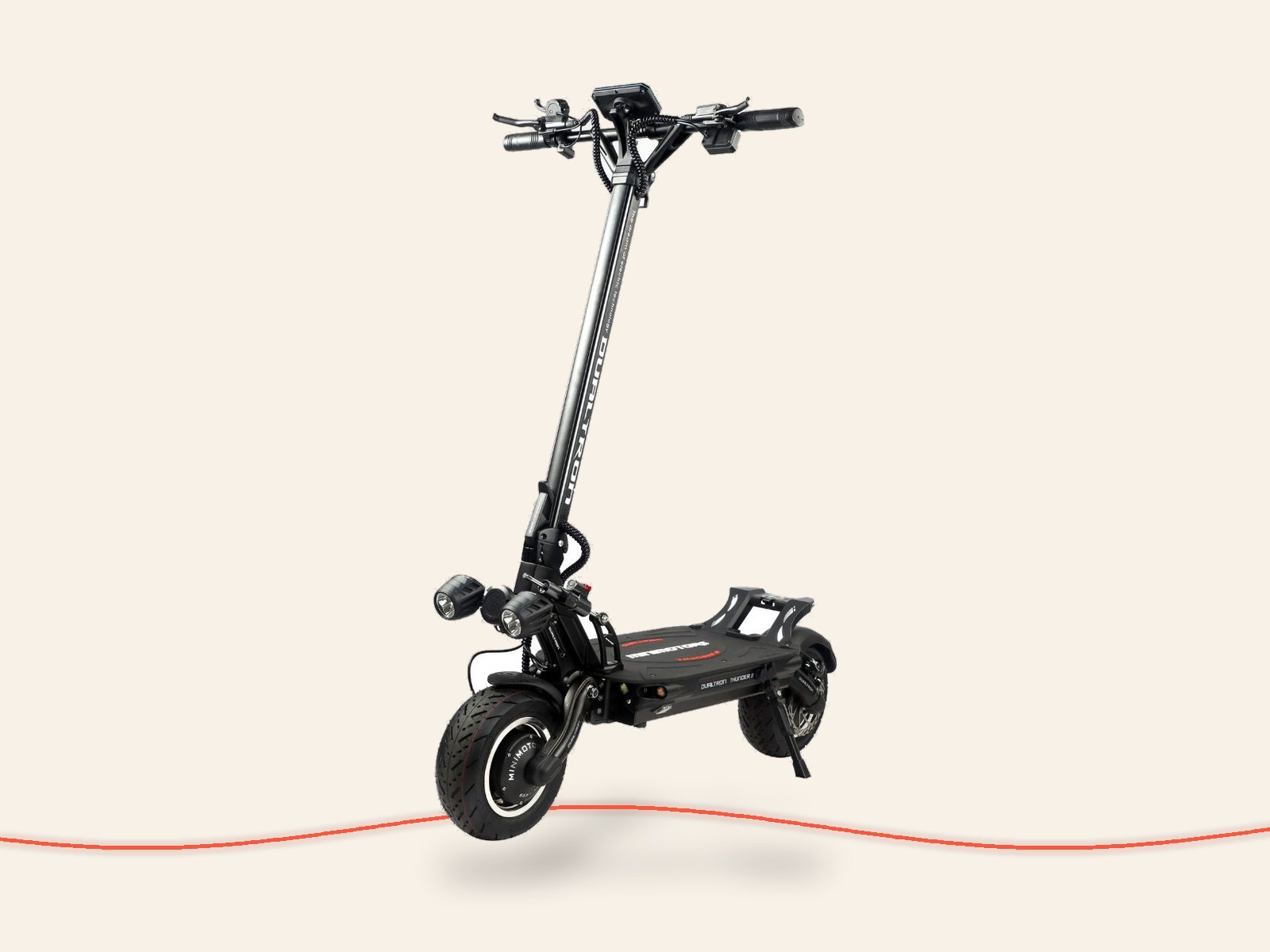
Dualtron Thunder 3
- Why shortlist it
- Massive claimed range, 4-piston hydraulic brakes and ultra-wide 11 inch tubeless tyres.
- Trade-off
- Very heavy at 47.3 kg, extremely expensive, and well outside the legal class at 100 km/h.
Compare current Dualtron electric scooters in Australia by price, range, weight, suspension, stock status and public-riding suitability.
Dualtron covers two very different markets: capped commuter models such as the Togo family and extremely fast private-land machines such as the Thunder 3. Decide where the scooter will be used before comparing batteries, motors or headline speed.
This live guide draws from ScootFinder's Australian Dualtron catalogue and keeps current models separate from run-out and discontinued stock.
Range estimates are ScootFinder estimates unless a tested result is explicitly labelled. Claimed range is the manufacturer's published best-case figure.
| Model | Dated price, AUD | Range, Estimated | Range, Claimed | Weight | Payload | Top speed | Legal class |
|---|---|---|---|---|---|---|---|
| Dualtron Thunder 3 | $7,499 | 119 km | 170 km | 47.3 kg | 120 kg | 100 km/h | Private land |
Adult Dualtron models are selected from verified Australian catalogue records. Published specifications and ScootFinder range estimates are research, not claims of physical testing.
A 25 km/h-capable label is a speed feature, not public-use approval. Device weight, dimensions, wheelbase, maximum power and Australian configuration can change the result. It does not override where, how fast or by whom it may be ridden. Check the current official rule for your jurisdiction before buying or riding.
A capped Togo-family model is the practical public-riding shortlist. The faster Mini and Thunder models are performance machines intended for private property.
The Thunder 3 has the highest claim in the current ScootFinder catalogue, but it is a 47.3 kg private-land device and was sold out at the Australian retailer when last checked.
No. Some Australian commuter variants fit the 25 km/h device class, while the faster performance models do not. State and territory rules still apply to the capable models.